Maple Slabs: How to Choose, Work, and Finish Hard and Soft Maple
What to look for in a maple slab, how hard and soft maple behave in the shop, and how to finish maple without blotching.
Quick answer: Maple for slabs comes in two commercial groups: hard maple (sugar maple, about 1,450 Janka) and soft maple (mostly red and silver maple, about 700–950 Janka). Both run cream to light brown, take a fine finish, and show dramatic figure—birdseye, curly or fiddleback, quilted, ambrosia, and spalting. Hard maple is denser and more wear-resistant; soft maple machines more easily and is often lighter. Maple burns with dull bits, tears out when figured, and blotches under pigment stain—so prefer clear oils or varnish, or use dye carefully. Choose kiln-dried stock, keep cutters sharp, and finish both faces.
Maple is one of the most familiar North American hardwoods, and one of the most useful for live edge work. Hard maple (Acer saccharum), also called sugar maple or rock maple, is the dense, pale wood behind bowling alleys, butcher blocks, and heavy-use tabletops. Soft maple is a lumberyard term for several lighter species—chiefly red maple (Acer rubrum) and silver maple (Acer saccharinum)—that look similar on the rack but cut and finish with less effort. Both deliver the light color, fine texture, and figure woodworkers chase in slab furniture, shelves, desks, and countertops. This guide covers how to tell them apart, what to look for when buying, how maple behaves in the shop, and how to finish it without blotching.
What is the difference between hard maple and soft maple?
The names are relative. Soft maple is not softwood; it is simply softer than hard maple. Hard maple sits near 1,450 pounds-force on the Janka scale and dries to about 44 pounds per cubic foot. Soft maple usually lands between about 700 and 950 Janka, with dried weights roughly in the 30–38 pounds-per-cubic-foot range depending on species. Red maple is the soft maple most often sold in the eastern United States; silver maple is lighter still.
In practice, hard maple resists dents better under heavy traffic. Soft maple is easier on tools, often cheaper, and still hard enough for furniture, mantels, and many tabletops. Color ranges overlap: sapwood is nearly white to creamy with a faint golden or pink cast; heartwood can be a light reddish brown. Unlike walnut, maple is usually sold for its sapwood, so pale, even color is the goal. Shrinkage is notable—hard maple runs roughly 4.8% radially and 9.9% tangentially—so a wide slab still moves with the seasons. Use the same movement-friendly fastening as on any other species. Neither hard nor soft maple is rated durable outdoors.
How do you choose a maple slab?
Start with drying and size, then look at figure, defects, and whether hard or soft maple suits the project.
Confirm kiln drying and moisture
Maple should be dried to a moisture content suited to indoor use before flattening and finishing. Wide maple slabs that are still wet can cup, check, or keep moving after the work is done. Our guide to why kiln-dried slabs matter covers how to check moisture with a meter and why air-dried-only stock is a gamble on large pieces.
Match hardness to the job
Choose hard maple for surfaces that take abuse: workbenches, high-traffic tops, chopping boards, and floors. Soft maple is a strong choice when weight matters, when you want easier machining, or when the slab will be painted or clear-finished rather than stained. Weight is often the quickest shop clue: hard maple feels markedly denser for the same thickness.
Look for figure
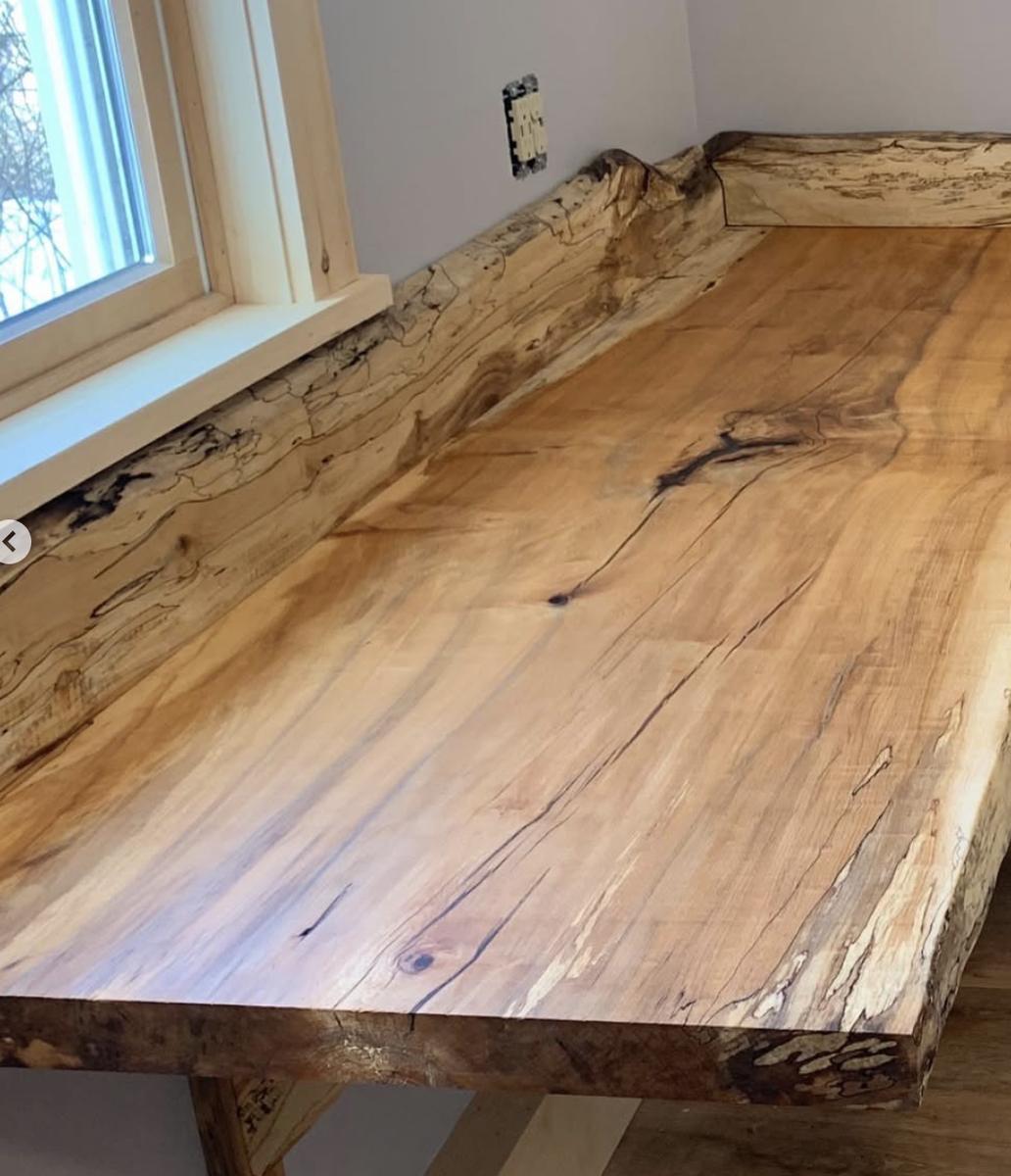
Maple produces some of the most prized figure in domestic wood. Birdseye shows as tiny dark “eyes” and is found almost exclusively in hard maple. Curly, fiddleback, tiger, and flame figure appear as rippling bands across the grain in both hard and soft maple; curl is usually strongest on quartersawn faces. Quilted maple has a rolling, three-dimensional look more often tied to bigleaf maple. Ambrosia maple is soft maple marked by ambrosia beetles—gray, brown, or bluish streaks around small pinholes. Spalting adds dark zone lines and soft mottling; striking, but softer wood that may need stabilizing. See our guides to burl wood and spalted wood.
Read the defects
End checks, bark inclusions, mineral streaks, and voids show up in maple as they do in other slabs. Stable cracks can be bridged with butterfly keys or filled with clear or tinted epoxy. Ambrosia pinholes are mostly cosmetic; seal them well so finish does not leave dull spots. Soft, punky spalted zones need epoxy or other stabilization before they will take a smooth surface.
Size the slab to the project
Measure finished length, width, and thickness first, then allow for trimming ends and flattening. Our guide to choosing slab size covers typical dimensions for common builds.
How does maple behave in the shop?
Straight-grained maple planes, routs, and sands to a glassy surface. It glues reliably and turns well. Hard maple dulls edges faster than soft maple. Both burn when high-speed cutters—especially router bits—linger or run dull; keep bits sharp, take light passes, and keep the bit moving. Figured stock tears out under a planer or dull iron because the grain reverses every few millimeters. Light passes, a sharp scraper, and a router sled for wide slabs avoid feeding curly or birdseye maple through a planer at all.
Maple dust is fine and pale. Like many hardwoods, maple has been reported as a sensitizer for some people, usually as respiratory or skin irritation with heavy exposure. Use dust collection and a respirator while sanding. Pale maple also shows dark dust from other species immediately—clean the work area before final sanding.
What tools and materials do you need to finish maple?
- A random-orbit sander with abrasives from 80 or 100 grit through 180 or 220 (finer for a glassy clear coat)
- A card scraper for curly, quilted, and birdseye areas
- Sharp router bits and plane irons; dull cutters burn maple quickly
- Dust collection or a shop vacuum and a respirator rated for fine dust
- Lint-free rags and a clean microfiber cloth
- Mineral spirits or naphtha for a pre-finish wipe-down
- Your chosen clear finish: a penetrating oil, a wiping varnish, an oil-based polyurethane, or a water-based polyurethane
- Optional for color: a water-soluble dye, dewaxed shellac washcoat, or gel stain—not ordinary pigment stain alone
How do you finish a maple slab, step by step?
- Flatten and repair. Flatten both faces, complete keys or epoxy fills, and let fills cure fully before final sanding.
- Sand in sequence. Work up through the grits without skipping more than one step. Scrape figured areas that tear under the sander. Stop at 180 or 220 for most oils; go finer if you want a high-build film finish.
- Clean thoroughly. Vacuum, then wipe with mineral spirits. The wipe removes dust and previews how the pale wood will look under finish.
- Test on an offcut. Maple’s blotching habit makes a sample board essential. Include any sapwood, heartwood, and figure that appear on the slab.
- Skip pigment stain unless you have a plan. Ordinary oil stain blotches on maple. Prefer a clear finish, a water-soluble dye (often sprayed or wiped over a thin shellac washcoat), or a gel stain that sits more on the surface.
- Apply the first clear coat. Flood on oil or wipe on a thin varnish coat, then wipe off the excess per the product’s directions. Water-based finishes keep maple cooler and whiter; oil-based products add a warm amber tone.
- Build the finish. Add coats as directed, scuffing lightly with fine abrasive between dry coats.
- Finish both faces and the edges. Coat the underside so moisture exchange stays even and the slab stays flatter.
- Let it cure before use. Allow the full cure time before heavy use, especially with oil-based products.
For a deeper look at finish types and long-term care, see our guide to caring for and finishing live edge slabs.
Why does maple blotch, and how do you avoid it?
Maple’s fine, dense grain absorbs pigment stain unevenly: dense latewood takes less color, thirsty earlywood drinks it in, and the surface looks patchy. Conditioner helps a little but rarely fixes hard maple. Better options: leave the wood natural under a clear oil or varnish; color with dye, which penetrates more evenly; seal with a thin dewaxed-shellac washcoat before a gel stain or glaze; or paint soft maple when a solid color is the goal. Figured and ambrosia maple almost always look best clear—stain muddies the figure.
What mistakes should you avoid with maple?
- Buying a slab without checking moisture content
- Assuming “soft maple” means softwood or that it cannot handle furniture use
- Running dull router bits or planer knives and burning the surface
- Feeding curly or birdseye maple through a planer with aggressive cuts
- Brushing on pigment stain without a sample board
- Sanding without dust protection
- Finishing only the top face
- Leaving ambrosia pinholes or soft spalted zones unsealed
If you are planning a maple project, browse kiln-dried slabs in the shop, including maple when it is in stock, or see the wood in person at the yard in Sharon, VT. Slabs can also ship by freight to the contiguous 48 states; the shipping page explains how. Prefer a darker domestic hardwood? Our black walnut slab guide covers the other end of the color spectrum.
FAQ: maple slabs
Is maple good for live edge slabs?
Yes. Maple's light color, fine texture, and figure make it a favorite for slab furniture, desks, shelves, and countertops. Hard maple is denser; soft maple is easier to machine and still strong enough for most furniture.
What is the difference between hard maple and soft maple?
Hard maple (sugar maple) is about 1,450 Janka and denser. Soft maple (mainly red and silver) usually falls around 700–950 Janka. Soft is relative—soft maple is still a hardwood comparable to cherry or walnut.
What is birdseye maple?
Birdseye is a figure, not a species. Tiny dark 'eyes' appear almost exclusively in hard maple. It is prized for furniture and instruments and needs sharp tools because the grain reverses around each eye.
Why does maple blotch when stained?
Maple's fine, dense grain absorbs pigment stain unevenly. Prefer a clear oil or varnish, a water-soluble dye (often over a thin shellac washcoat), or a gel stain. Test on an offcut first.
Does maple burn when routing?
Yes, especially with dull bits or slow feed. Keep cutters sharp, take light passes, and keep the bit moving. Hard maple burns more readily than soft maple.
Should I use hard or soft maple for a tabletop?
Hard maple resists dents better under heavy use. Soft maple is lighter, easier to work, and fine for many tabletops if the surface will not take constant abuse. Match hardness to expected wear.
Is maple durable outdoors?
No. Both hard and soft maple are rated non-durable and are best kept as interior woods.