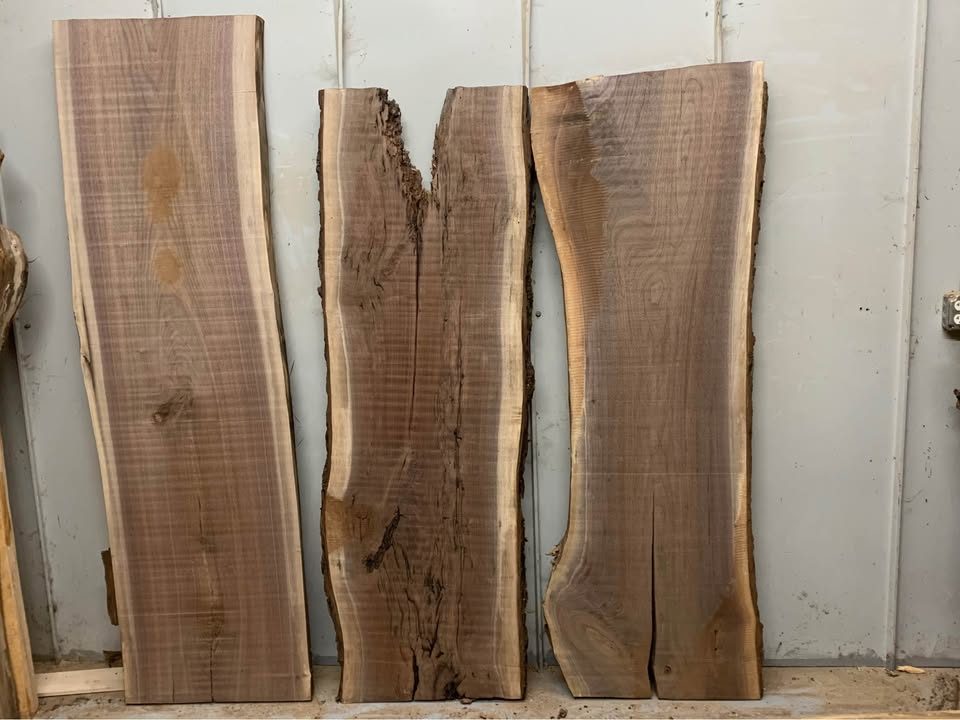
Black Walnut Slabs: How to Choose, Work, and Finish Walnut
What to look for in a black walnut slab, how walnut behaves in the shop, and how to finish it so the color and figure show at their best.
Quick answer: Black walnut is a medium-density North American hardwood with chocolate-brown heartwood, creamy sapwood, and a reputation for working and finishing beautifully. When choosing a walnut slab, check that it is properly dried, decide early whether the pale sapwood is a feature or waste, look for figure such as crotch or curl, and plan around cracks and knots. Walnut machines cleanly with sharp tools, needs dust protection, and is rarely stained. A penetrating oil or an oil-based finish deepens its color, while water-based finishes keep it cooler and lighter. Expect untouched walnut to mellow toward a warmer, slightly lighter brown over time.
Few domestic woods are as widely loved as black walnut (Juglans nigra). It grows across the eastern United States, it is strong without being hard to work, and its dark heartwood looks rich with nothing more than a coat of oil. Those same qualities make it one of the most popular species for live edge furniture, mantels, shelves, benches, and countertops. This guide covers what to look for in a walnut slab, how the wood behaves in the shop, and how to finish it so the color and figure show at their best.
What makes black walnut a good slab wood?
Walnut sits in a useful middle ground. With a Janka hardness of about 1,010 pounds-force, it is softer than hard maple or white oak but firm enough for tabletops, desks, and benches that see daily use. It dries to roughly 38 pounds per cubic foot, so a large slab is heavy but manageable with a helper or two.
It is also one of the more dimensionally stable domestic hardwoods. Published shrinkage figures from green to oven-dry are about 5.5% radially and 7.8% tangentially, with a low ratio between the two, which means walnut is less prone to severe cupping and distortion than many species. Stable does not mean static, though: a wide walnut slab still swells and shrinks across its width with the seasons, so the same movement-friendly fastening applies here as with any other slab. The heartwood is rated very durable against decay, and the grain is usually straight with a medium texture and a soft natural luster.
How do you choose a black walnut slab?
Start with the basics that apply to any slab, then look at the traits specific to walnut.
Check the drying
A slab should be dried to a moisture content suited to indoor use before it is flattened and finished. Air-dried walnut that has not reached equilibrium can keep moving, checking, or cupping after the work is done. Our guide to why kiln-dried slabs matter explains the difference and how to check moisture with a meter.
Decide what to do with the sapwood
Walnut sapwood is pale yellow-gray to nearly white, and on a live edge slab it forms a band of light wood just inside the bark. Some woodworkers treat that contrast as the whole point, framing the dark heartwood with a bright edge. Others want a uniform brown and trim it away, which can cost several inches of width. Decide before buying, because a slab that is wide enough with sapwood may be too narrow without it. Commercial walnut lumber is sometimes steamed to blend the two colors, which darkens the sapwood but can also mute the heartwood.
Look for figure
Walnut produces some of the most dramatic figure of any domestic wood. Crotch figure, where the trunk divides into two limbs, creates a feathered or flame pattern down the middle of the slab. Curl shows as rippling bands of light across the grain, and burls carry tight, swirling clusters of tiny knots. Figure adds character and value, but it also adds working challenges. For more on figured stock, see our guide to burl wood.
Read the defects
Cracks, end checks, bark inclusions, and voids are common in walnut slabs, especially near the pith and in crotch sections. Most are manageable. Stable cracks can be bridged with butterfly keys or filled with tinted epoxy. Check that any crack has stopped growing, and plan the layout so defects land where they add character rather than where a base or a joint needs solid wood.
Match the size to the project
Measure the finished dimensions before shopping, then add allowance for trimming ends, flattening, and removing sapwood if needed. Our guide to choosing slab size covers typical dimensions for common projects.
How does walnut behave in the shop?
Straight-grained walnut planes, routs, and sands cleanly, and it holds crisp edges and details. It glues well with ordinary wood glue. Irregular and figured grain is a different story: crotch and curl sections tear out easily under a planer or a dull router bit, so take light passes, keep cutters sharp, and expect to finish those areas with a scraper or sander. Flattening a wide slab with a router sled avoids feeding figured stock through a planer at all.
Walnut dust is fine and dark, and black walnut has been reported as a sensitizer. Reactions are usually limited to eye and skin irritation, but repeated exposure can make them worse. Use dust collection and a well-fitted respirator, especially during sanding. Wipe down surfaces between grits, since dark walnut dust lodges easily in light sapwood and open pores.
One more shop note: walnut sapwood is susceptible to insect attack even though the heartwood resists decay. Properly kiln-dried stock is far less likely to carry live insects, but it is still worth inspecting any slab for small round exit holes and fine powdery dust before it comes inside.
What tools and materials do you need to finish walnut?
- A random-orbit sander with abrasives from 80 or 100 grit through 180 or 220
- A card scraper for figured and crotch areas
- Dust collection or a shop vacuum and a respirator rated for fine dust
- Lint-free rags and tack cloths, or a clean, dry microfiber cloth
- Mineral spirits or naphtha for a wipe-down before finishing
- Your chosen finish: a penetrating oil, a wiping varnish, an oil-based polyurethane, or a water-based polyurethane
- Optional: a paste grain filler for a mirror-smooth surface
How do you finish a black walnut slab, step by step?
- Flatten and repair. Flatten both faces, complete any keys or epoxy fills, and let fills cure fully before final sanding.
- Sand in sequence. Work up through the grits without skipping more than one step, and scrape figured areas that resist sanding. Walnut rarely needs to go finer than 180 to 220 grit for an oil finish.
- Clean thoroughly. Vacuum, then wipe with a cloth dampened with mineral spirits. This removes dust from the pores and previews how the wood will look under finish.
- Test on an offcut or the underside. Try the finish on a sample that includes both heartwood and sapwood, since the two react differently.
- Fill the grain if you want a glassy surface. Walnut has open pores. Leave them open for a natural, low-sheen feel, or use a dark paste filler before topcoats for a smooth, reflective finish.
- Apply the first coat. Flood on oil or wipe on a thin coat of varnish, let it penetrate, and wipe off the excess per the product's directions.
- Build the finish. Add coats as the product recommends, scuffing lightly with fine abrasive between coats once each is dry.
- Finish both faces. Coat the underside and edges too, so the slab exchanges moisture evenly and stays flat.
- Let it cure before use. Allow the full cure time, which is often several weeks for oil-based products, before heavy use.
For a deeper look at finish types and long-term care, see our guide to caring for and finishing live edge slabs.
Should you stain black walnut?
Almost never. The heartwood already has the deep color most stains try to imitate, and stain tends to blur its figure. Finish choice does the coloring instead. Oils and oil-based varnishes add warmth and darken the wood noticeably. Water-based finishes stay clearer and cooler, which some woodworkers prefer and others find flat or gray on walnut. A thin first coat of oil under a water-based topcoat is a common way to get warmth plus the durability of a modern finish.
Unlike most woods, which darken with age, walnut heartwood tends to lighten and warm toward a golden brown with exposure to light. A finish with UV inhibitors slows that change, and keeping objects from sitting in one spot in direct sun prevents uneven patches.
What mistakes should you avoid with walnut?
- Buying a slab without deciding whether the sapwood stays
- Feeding crotch or curly walnut through a planer with dull knives
- Sanding without dust protection
- Staining over walnut's natural color and hiding the figure
- Skipping a test board and being surprised by how water-based finish looks
- Leaving walnut dust in the sapwood or pores before finishing
- Finishing only the top face
- Expecting walnut to stay exactly the color it was on day one
If you are planning a walnut project, browse kiln-dried slabs in the shop, including walnut when it is in stock, or see the wood in person at the yard in Sharon, VT. Slabs can also ship by freight to the contiguous 48 states; the shipping page explains how. Working with something paler? Our spalted wood guide covers a very different kind of character.
FAQ: black walnut slabs
Is black walnut good for live edge slabs?
Yes. Walnut is strong, relatively stable, easy to work, and very durable against decay, and its dark heartwood looks rich with a simple oil finish. It is one of the most popular species for slab furniture, mantels, shelves, and countertops.
How hard is black walnut?
Black walnut has a Janka hardness of about 1,010 pounds-force. That is softer than hard maple or white oak but hard enough for tabletops, desks, and benches in daily use.
Should you keep the sapwood on a walnut slab?
It is a design choice. The pale band contrasts with the dark heartwood and highlights the live edge. Removing it gives a uniform color but can cost several inches of width, so decide before buying.
What is the best finish for black walnut?
Penetrating oils and oil-based varnishes deepen walnut's color and add warmth. Water-based finishes keep it lighter and cooler. Test on an offcut with both heartwood and sapwood.
Does black walnut darken over time?
Walnut heartwood usually lightens and warms toward a golden brown with light exposure, the opposite of many woods. UV-inhibiting finishes slow the change.
Is walnut dust harmful?
Black walnut has been reported as a sensitizer, usually causing eye and skin irritation. Use dust collection and a respirator, especially while sanding.