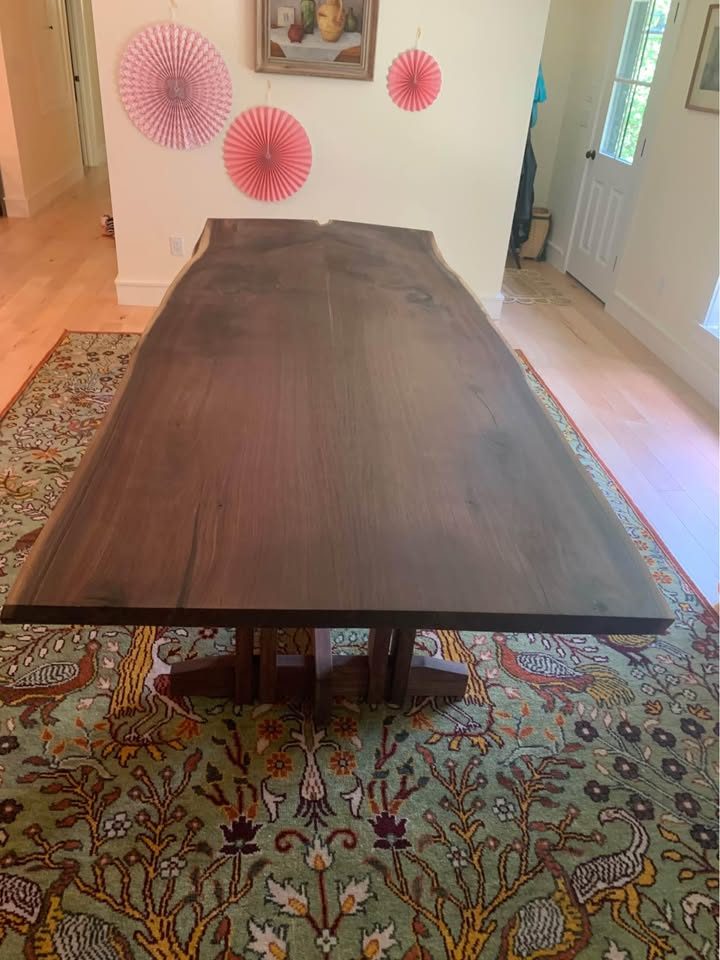
How to Care for and Finish Live Edge Slabs
A practical guide to finishing and maintaining kiln-dried live edge slabs—prep, finish choices, humidity, mounting, and repairs—for DIYers and woodworkers.
Quick answer: Finish live edge slabs on all faces (including underside and end grain), keep indoor relative humidity roughly in the mid-30s to mid-50s percent when you can, and choose a finish that matches how the piece will be used. Mount wide tops with hardware that allows cross-grain movement, and clean with mild methods matched to the finish system.
A kiln-dried live edge slab is furniture stock with a natural edge retained from the log. Once it leaves the rack, its long-term look depends less on mystery products and more on preparation, a finish matched to use, stable indoor moisture, and mounting that respects cross-grain movement. This guide is for DIYers, furniture makers, carpenters, and woodworkers building or maintaining slab projects in the shop—not a homeowner care pamphlet.
What tools and materials do you need to finish a live edge slab?
Exact tooling depends on whether the slab still needs flattening. A typical furniture path includes:
- Support and handling: sturdy sawhorses or a flat assembly table, moving straps or help for heavy pieces
- Flattening: router sled and straight bit, or access to a wide-belt / drum sander; winding sticks and a long straightedge
- Shaping and cleanup: hand planes, spokeshave or rasps for live-edge refinement, random-orbit sander
- Abrasives: progressive grits (often from coarse leveling grits up through about 180–220 for many film finishes; oil systems sometimes stop a bit coarser—follow the finish maker)
- Stabilization (as needed): epoxy suited to wood voids, mixing cups, pigment if desired, clamps; butterfly (bowtie) keys and a router/inlay kit for structural cracks
- Finishing: chosen oil, hardwax oil, wiping varnish, or polyurethane/lacquer system; lint-free rags or brushes/foam applicators; respirator and ventilation appropriate to the product
- Mounting: figure-eight fasteners, Z-clips, desktop fasteners, or slotted screw holes in the base apron
How should you prepare a kiln-dried slab before finishing?
Why acclimate before you flatten?
Even kiln-dried stock continues to exchange moisture with the air. Bring the slab into the shop or destination environment, support it flat with both faces able to breathe, and give it several days to a couple of weeks before you commit to final flattening. That reduces the chance you flatten to a plane that shifts as the faces equalize.
What does flattening remove?
Most slabs arrive with some cup, twist, or high spots. Router sleds and wide-belt sanders remove thickness to create a true working face. Plan for material loss when you choose thickness for span and base design. Check progress with a straightedge across and along the slab.
When do butterfly keys and epoxy make sense?
Natural checks and voids are common. Epoxy can stabilize voids and create a clean working surface where debris or liquids would otherwise collect. Butterfly keys lock cracks that may propagate across a top. Cosmetic hairline checks in stable stock are often left alone. Match epoxy working time and viscosity to the void size, and sand flush after full cure.
What grit sequence works for most furniture slabs?
After flattening, sand with the grain through a logical sequence. Skipping large grit jumps leaves deeper scratches that telegraph under clear finishes—especially on hard maples and other fine-textured woods. Vacuum and tack between grits. Soft species need a lighter touch so you do not dish earlywood or round over the live edge unintentionally.
Which finish types work best on live edge slabs?
There is no single “best” finish—only a best match for abrasion, look, repairability, and skill level.
What are oil and hardwax-oil finishes good for?
Penetrating oils and hardwax oils leave more of the wood’s texture under the hand and are often easier to spot-refresh. They typically need more disciplined cleaning habits and periodic maintenance on high-wear surfaces. Always use the maintenance product specified for that system; products are not freely interchangeable.
When should you choose a film finish?
Polyurethane, wiping varnish, lacquer, and conversion varnish build a protective layer on top of the wood. They generally offer stronger short-term resistance to casual spills and abrasion. Repairs that go through the film are harder to hide. Water-based polyurethanes amber less; oil-based versions add warmth. Apply thin coats, sand lightly between coats as directed, and finish the underside and end grain as well as the show face.
Should you finish only the top?
No. An unfinished underside exchanges moisture faster than a sealed top, which encourages cupping. Coat edges and end grain—end grain takes finish greedily and is a fast path for moisture. Cutouts, fastener holes, and epoxy boundaries deserve attention too.
How do humidity and seasonal movement affect finished slabs?
Solid wood expands as humidity rises and shrinks as humidity falls—mostly across the width of a flatsawn or mostly flatsawn slab. For many shops and interiors, keeping relative humidity roughly between the mid-30s and mid-50s percent reduces stress. Winter heating in cold climates often drives air very dry; small checks can open and later ease. Avoid parking finished work directly above radiators or tight against damp exterior walls.
Mount wide tops so the base does not fight width change: figure-eights, Z-clips, slotted holes, or similar hardware. Do not glue a wide slab rigidly across its full width to a metal frame or solid apron without a movement plan.
How do you clean and maintain a finished live edge project?
Identify the finish before you maintain it. Film finishes do not want furniture oil on top. Oil and hardwax systems may need thin maintenance coats when the surface looks dry or water no longer beads—as directed by the manufacturer. Daily cleaning is usually a soft cloth; sticky residue yields to diluted mild dish soap, then a clean rinse wipe and dry. Skip bleach, ammonia, abrasive pads, and silicone sprays.
Keep open voids and bark features clean and dry. Bark is decorative structure, not armor—protect it from impacts and soaking. Use trivets under hot cookware on dining and kitchen surfaces; prolonged heat can soften finishes and drive moisture unevenly.
What mistakes should you avoid?
- Finishing only the show face
- Rigidly fastening a wide top with no allowance for movement
- Rushing from delivery to glue-up without acclimation
- Leaving thick pools of oil or finish that cure tacky
- Cutting food directly on a finished top
- Storing slabs on edge, on damp floors, or in hot sun for long periods
- Assuming every crack needs epoxy or every epoxy fill stops seasonal movement at the wood boundary
Browse kiln-dried slabs and burls in the shop, compare pieces in person at the Sharon, VT yard, or read why kiln-dried slabs matter and how to choose slab size for a project. Freight to the lower 48 is available—see shipping.
FAQ: finishing and caring for live edge slabs
Should you finish both sides of a live edge slab?
Yes. Finishing the top, underside, edges, and exposed end grain helps the slab exchange moisture more evenly and reduces the chance of cupping toward an unfinished face.
What indoor humidity is best for solid slab furniture?
Many furniture makers aim for roughly 35–55% relative humidity. Sharp swings matter more than a single perfect number; very dry winter heat often opens small checks.
Can you put oil on a polyurethane-finished slab?
Generally no. Film finishes such as polyurethane or lacquer do not need oiling; oil on top can leave residue and complicate later repairs.
How do you clean a finished live edge slab?
Use a soft dry or slightly damp cloth for daily cleaning. Mild dish soap diluted in water handles sticky spots. Avoid bleach, ammonia, abrasives, and silicone sprays.
Do live edge slabs need butterfly keys?
Not always. Butterflies (bowties) stabilize cracks that may grow or that cross a working surface. Cosmetic checks in stable, kiln-dried stock are often left as character.
How long should a finish cure before use?
Follow the product’s full cure schedule. Many oil and film systems need days—not just overnight dry-to-touch—before hard service.
Is bark on a live edge durable?
Bark is fragile. Keep it dry, avoid impacts and soaking, and expect it to be more maintenance-sensitive than the heartwood face.